Human Reproduction Update
The kisspeptin-GnRH pathway in human reproductive health and disease
Skorupskaite K, George JT, Anderson RA
2014 · DOI: 10.1093/humupd/dmu009 · PMID: 24615662
Read on PubMed ↗
Researcher attestation
Aero Peptides supplies research-grade peptides for in-vitro and laboratory use only. Not for human or veterinary consumption.
By entering you confirm that:
Acceptance stored locally for 180 days.
Free US shipping over $150Free domestic shipping on all orders over $150
Growth Hormone Support
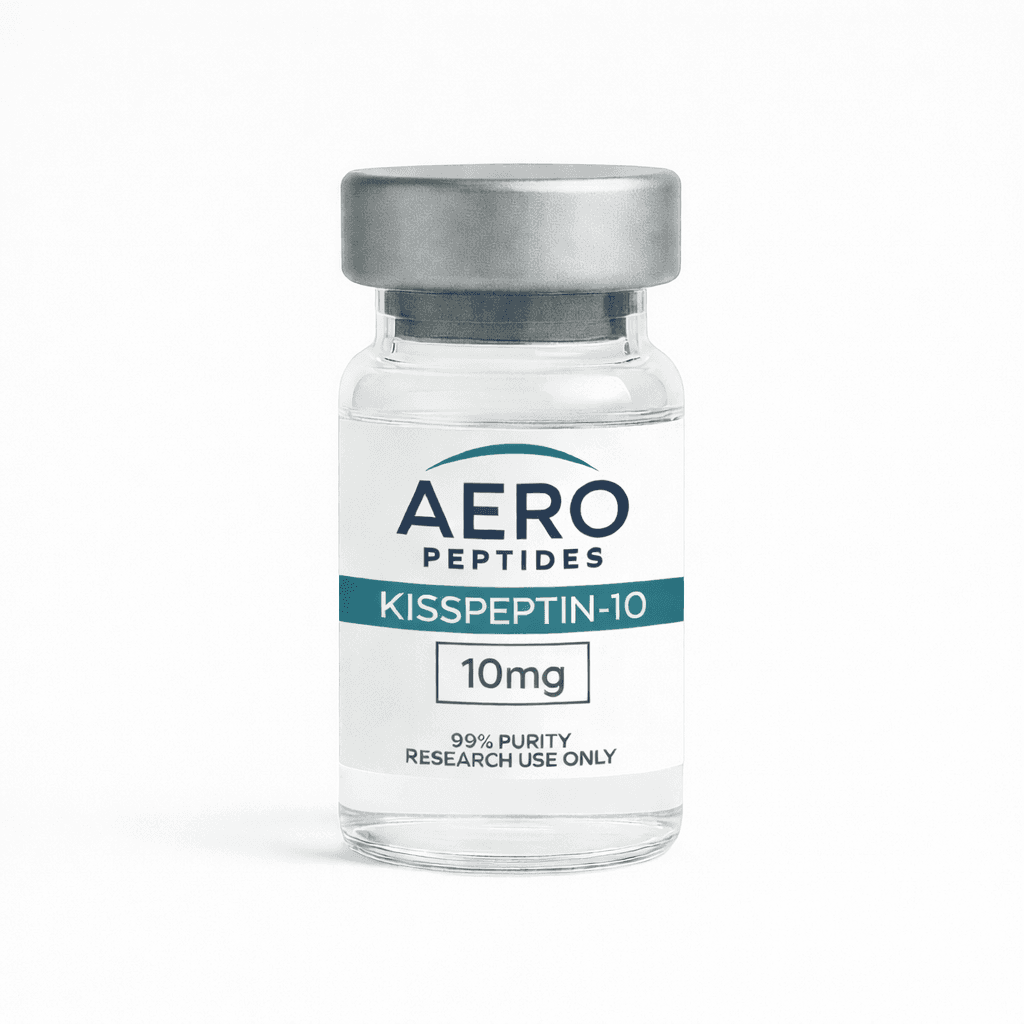
Kisspeptin-10 is the C-terminal decapeptide of metastin, the shortest fully-active fragment of the KISS1 gene product. Published preclinical and clinical research has characterised its interaction with the KISS1R (GPR54) receptor in studies of hypothalamic GnRH neurosecretion, pulsatile LH release, and the upstream regulation of the reproductive neuroendocrine axis. Loss-of-function work in GPR54-null models established the receptor as essential for normal pubertal onset, and subsequent ligand-identification studies mapped the active C-terminal RF-amide motif shared by KP-10. For laboratory and research use only.
Dosage
10MG$39.99
Bundle & Save
Discount applied automatically at checkout. Add 3+ for the best price per vial.
Quantity
Research focus
Summary of contexts in which this compound appears in the preclinical literature. See cited studies for primary sources.
Kisspeptin-10 is the C-terminal decapeptide of metastin, the shortest fully-active fragment of the KISS1 gene product. Published preclinical and clinical research has characterised its interaction with the KISS1R (GPR54) receptor in studies of hypothalamic GnRH neurosecretion, pulsatile LH release, and the upstream regulation of the reproductive neuroendocrine axis. Loss-of-function work in GPR54-null models established the receptor as essential for normal pubertal onset, and subsequent ligand-identification studies mapped the active C-terminal RF-amide motif shared by KP-10. For laboratory and research use only.
Areas of research interest
Technical specifications
Compound Information
Decapeptide (kisspeptin active fragment)
Storage & Stability
Lyophilized (powder)
-20°C • long-term stable in sealed lyophilized form
Reconstituted
2-8°C • use within 30 days of reconstitution
Light
Protect from light during storage and reconstitution
Room temperature
Short-term tolerant during shipping; minimise extended exposure above 25°C
Dosing in the literature
Observational summary of values reported in published research. Not a guide for human or animal use.
Reconstitution
Typically 1–2 mL bacteriostatic water per 10 mg vial, yielding a ~5–10 mg/mL working concentration in research preparations.
Published protocols
Dhillo et al. 2005 (JCEM, PMID 16174713) used IV infusion of kisspeptin-54 at 0.24–9.6 nmol/kg/h to characterise HPG-axis stimulation in human males; KP-10 was employed in preclinical receptor-characterisation studies (Messager et al. 2005, PNAS, PMID 15665093) at nanomolar concentrations via central and peripheral administration in rodent models.
Half-life
Very short — on the order of minutes following IV administration in rodent models, attributed to rapid endopeptidase cleavage of the decapeptide. Published half-life values for KP-10 specifically derive from preclinical PK data; no dedicated human KP-10 PK trial is cited on this file.
Post-reconstitution stability
~28 days at 2–8 °C in BAC-water solution.
Receptor-activation and administration details from Messager et al. 2005 (PMID 15665093) and Dhillo et al. 2005 (PMID 16174713). KP-10 half-life based on general RF-amide decapeptide PK literature; no dedicated human KP-10 PK trial is cited on this file.
Sources & references
Human Reproduction Update
The kisspeptin-GnRH pathway in human reproductive health and disease
Skorupskaite K, George JT, Anderson RA
2014 · DOI: 10.1093/humupd/dmu009 · PMID: 24615662
Read on PubMed ↗Reviews in Endocrine and Metabolic Disorders
The neuroendocrine physiology of kisspeptin in the human
Dhillo WS, Murphy KG, Bloom SR
2007 · DOI: 10.1007/s11154-007-9029-1 · PMID: 17323132
Read on PubMed ↗The Lancet Diabetes & Endocrinology
Pubertal development and regulation
Abreu AP, Kaiser UB
2016 · DOI: 10.1016/S2213-8587(15)00418-0 · PMID: 26852256
Read on PubMed ↗Molecular and Cellular Endocrinology
Hypothalamo-Pituitary axis and puberty
Spaziani M, Tarantino C, Tahani N, et al.
2021 · DOI: 10.1016/j.mce.2020.111094 · PMID: 33271219
Read on PubMed ↗Biochemistry (Moscow)
Role of Kisspeptin in Regulation of Reproductive and Immune Reactions
Gorbunova OL, Shirshev SV
2020 · DOI: 10.1134/S0006297920080015 · PMID: 33045946
Read on PubMed ↗New England Journal of Medicine
The GPR54 gene as a regulator of puberty
Seminara SB, Messager S, Chatzidaki EE, Thresher RR, Acierno JS Jr, et al.
2003 · DOI: 10.1056/NEJMoa035322 · PMID: 14573733
Read on PubMed ↗Proceedings of the National Academy of Sciences USA
Hypogonadotropic hypogonadism due to loss of function of the KiSS1-derived peptide receptor GPR54
de Roux N, Genin E, Carel JC, Matsuda F, Chaussain JL, Milgrom E
2003 · DOI: 10.1073/pnas.1834399100 · PMID: 12944565
Read on PubMed ↗Proceedings of the National Academy of Sciences USA
Kisspeptin directly stimulates gonadotropin-releasing hormone release via G protein-coupled receptor 54
Messager S, Chatzidaki EE, Ma D, et al.
2005 · DOI: 10.1073/pnas.0409330102 · PMID: 15665093
Read on PubMed ↗Journal of Clinical Endocrinology & Metabolism
Kisspeptin-54 stimulates the hypothalamic-pituitary gonadal axis in human males
Dhillo WS, Chaudhri OB, Patterson M, et al.
2005 · DOI: 10.1210/jc.2005-1468 · PMID: 16174713
Read on PubMed ↗Nature
Metastasis suppressor gene KiSS-1 encodes peptide ligand of a G-protein-coupled receptor
Ohtaki T, Shintani Y, Honda S, et al.
2001 · DOI: 10.1038/35079135 · PMID: 11385580
Read on PubMed ↗Journal of Biological Chemistry
The metastasis suppressor gene KiSS-1 encodes kisspeptins, the natural ligands of the orphan G protein-coupled receptor GPR54
Kotani M, Detheux M, Vandenbogaerde A, et al.
2001 · DOI: 10.1074/jbc.M104847200 · PMID: 11457843
Read on PubMed ↗11 peer-reviewed references listed. Citations verified against NCBI PubMed records. For research and educational reference only — does not constitute medical advice.
Researcher FAQ
No. Aero Peptides materials are sold exclusively for in-vitro research and laboratory analytical use. They are not intended to diagnose, treat, cure, or prevent any disease, and are not approved for human or animal administration.
By placing an order, you confirm that you are a qualified researcher and that the material will be used in accordance with all applicable institutional and jurisdictional regulations.
Each lot is independently tested for identity, purity, and mass using HPLC and mass spectrometry. The COA lists the lot number, test date, assay results, and the laboratory that performed the analysis.
Public COA documents are being prepared. In the meantime, you can request a COA for your specific lot and we’ll email it within 1 business day.
Orders ship quickly after your order is placed, from the US. Lyophilized peptides are shipped with insulation appropriate to season; short-term ambient excursions during transit do not measurably affect potency.
On receipt, store at −20°C in the sealed vial until reconstitution. See the handling matrix for full storage parameters. Tracked shipping is included; we ship to all US states and most international destinations.
Most peptides are reconstituted with bacteriostatic water (BAC). The volume depends on the target working concentration. Use our Peptide Calculator to compute volume, U-100 insulin syringe units, and doses per vial from peptide mass and target dose.
Once reconstituted, store at 2–8°C and use within 30 days. Protect the vial from light during storage and handling.
Because peptides are temperature-sensitive research materials, we cannot accept returns of opened or unsealed vials. If a shipment arrives damaged or the seal is broken on arrival, contact us within 7 days and we’ll replace or refund.
See our full returns policy for details.
Don’t see your question? Contact our research team — we typically reply within one business day.
In the same category
Frequently paired
⚠ Important research notice
Not for human consumption. This product is sold exclusively for research and educational purposes. It is not intended to diagnose, treat, cure, or prevent any disease.
All clinical trial data and research findings presented on this page are sourced from peer-reviewed journals and official publications. They are provided for educational reference only and should not be interpreted as medical advice or product claims.
By purchasing this product, you confirm that you are a qualified researcher and will use it in accordance with all applicable laws and regulations.