Biochemical Journal
Insulin-like growth factor-I (IGF-I) and especially IGF-I variants are anabolic in dexamethasone-treated rats
Tomas FM, Knowles SE, Owens PC, et al.
1992 · PMID: 1540680
Read on PubMed ↗
Researcher attestation
Aero Peptides supplies research-grade peptides for in-vitro and laboratory use only. Not for human or veterinary consumption.
By entering you confirm that:
Acceptance stored locally for 180 days.
Free US shipping over $150Free domestic shipping on all orders over $150
Growth Hormone Support
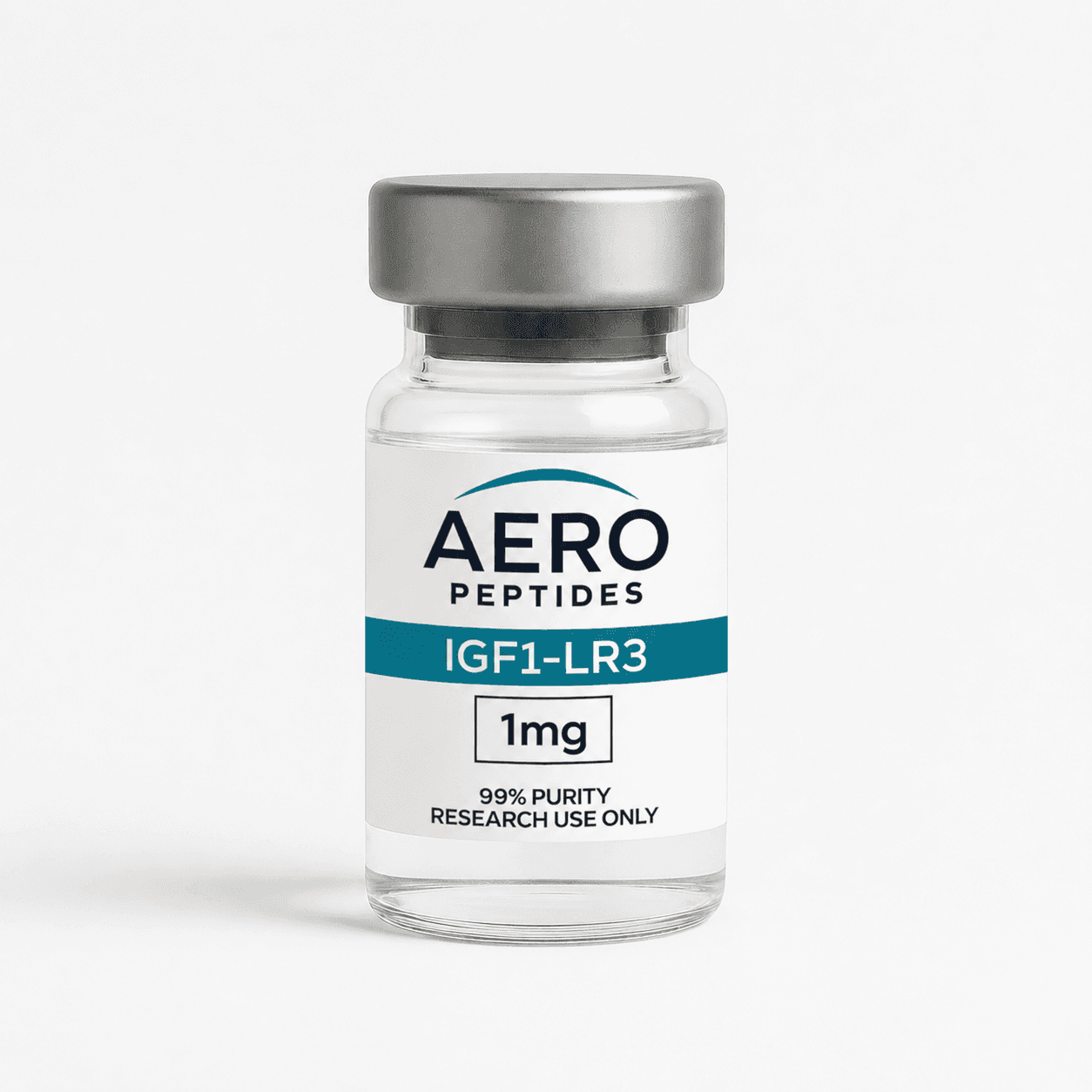
IGF1-LR3 is a recombinant 83-residue analogue of human insulin-like growth factor 1, engineered with a 13-amino-acid N-terminal extension and a single Arg-for-Glu substitution at position 3. Both modifications reduce binding to the IGF-binding-protein (IGFBP) family while preserving affinity for the type-1 IGF receptor, producing substantially longer in-vitro half-life and free-fraction activity than native IGF-1. The variant was characterised in the late-1980s/early-1990s CSIRO Adelaide group work (Ballard, Francis, Wallace) and is widely used in cell-culture and preclinical model systems studying protein synthesis, cell proliferation, anti-apoptotic signalling, and tissue-specific IGF1R pharmacology. For laboratory and research use only.
Research focus
Summary of contexts in which this compound appears in the preclinical literature. See cited studies for primary sources.
IGF1-LR3 is a recombinant 83-residue analogue of human insulin-like growth factor 1, engineered with a 13-amino-acid N-terminal extension and a single Arg-for-Glu substitution at position 3. Both modifications reduce binding to the IGF-binding-protein (IGFBP) family while preserving affinity for the type-1 IGF receptor, producing substantially longer in-vitro half-life and free-fraction activity than native IGF-1. The variant was characterised in the late-1980s/early-1990s CSIRO Adelaide group work (Ballard, Francis, Wallace) and is widely used in cell-culture and preclinical model systems studying protein synthesis, cell proliferation, anti-apoptotic signalling, and tissue-specific IGF1R pharmacology. For laboratory and research use only.
Areas of research interest
Technical specifications
Compound Information
Recombinant IGF-1 analogue (Long R3 variant)
Storage & Stability
Lyophilized (powder)
-20°C • long-term stable in sealed lyophilized form
Reconstituted
2-8°C • use within 30 days of reconstitution
Light
Protect from light during storage and reconstitution
Room temperature
Short-term tolerant during shipping; minimise extended exposure above 25°C
Compound-specific notes
Lyophilised IGF1-LR3 is stable for extended periods at −20 °C protected from light. Reconstituted solution is best used within 14–28 days at 2–8 °C; do not refreeze. The variant is sensitive to repeated freeze-thaw cycles and to surface adsorption — researchers typically aliquot and use low-binding polypropylene to minimise loss.
Dosing in the literature
Observational summary of values reported in published research. Not a guide for human or animal use.
Reconstitution
IGF1-LR3 is supplied as a 1 mg lyophilised vial. Reconstitution practice in cell-culture work typically uses 1 mL of bacteriostatic water or 0.1 % BSA-acidic-buffer to yield a 1 mg/mL stock; further dilution into culture medium follows the assay protocol. The Long R3 variant adsorbs to glass and untreated polystyrene more readily than other peptides — low-binding polypropylene is the conventional choice.
Published protocols
Cell-culture protocols typically use IGF1-LR3 at 1–100 ng/mL in serum-free or low-serum media for proliferation, protein-synthesis, or survival endpoints (Ballard/Francis CSIRO work; subsequent muscle-cell and adipocyte studies). Preclinical rodent anabolic-model dosing in the cited Tomas 1992 work used roughly 100–250 µg/kg/day subcutaneous infusion. There is no published research-protocol standard equivalent to a clinical dose.
Half-life
Native IGF-1 plasma half-life is ~10 minutes free / ~12–15 hours bound to IGFBP-3 ternary complex. IGF1-LR3's reduced IGFBP binding produces a longer free-fraction in-vitro effective half-life (commonly reported ~20–30 hours in cell-culture media); circulating-plasma half-life in vivo is also extended relative to native IGF-1 in the cited Tomas 1992 rodent work, though exact pharmacokinetic figures vary by model.
Post-reconstitution stability
Reconstituted IGF1-LR3 retains activity for ~14–28 days at 2–8 °C protected from light when stored in low-binding polypropylene. Repeated freeze-thaw degrades activity; aliquoting before freezing is conventional. Activity loss is gradual rather than abrupt.
Anabolic-dose range from Tomas et al. (Biochem J 1992, PMID 1540680). Variant characterisation from King et al. (J Mol Endocrinol 1992, PMID 1547202) and Francis et al. (Biochem J 1992, PMID 1280101). IGF1R pharmacology summarised in Adams et al. (Cell Mol Life Sci 2000, PMID 10961344). IGFBP binding modulation in Hwa et al. (Endocr Rev 1999, PMID 10605625). PMIDs and dose figures should be cross-checked against PubMed before citation in any publication.
Sources & references
Biochemical Journal
Insulin-like growth factor-I (IGF-I) and especially IGF-I variants are anabolic in dexamethasone-treated rats
Tomas FM, Knowles SE, Owens PC, et al.
1992 · PMID: 1540680
Read on PubMed ↗Journal of Molecular Endocrinology
Production and characterization of recombinant insulin-like growth factor-I (IGF-I) and potent analogues of IGF-I, with Gly or Arg substituted for Glu3, following their expression in Escherichia coli as fusion proteins
King R, Wells JR, Krieg P, Snoswell M, Brazier J, Bagley CJ, Wallace JC, Ballard FJ, Ross M, Francis GL
1992 · PMID: 1547202
Read on PubMed ↗Cellular and Molecular Life Sciences
Structure and function of the type 1 insulin-like growth factor receptor
Adams TE, Epa VC, Garrett TP, Ward CW
2000 · DOI: 10.1007/PL00000744 · PMID: 10961344
Read on PubMed ↗Endocrine Reviews
The insulin-like growth factor-binding protein (IGFBP) superfamily
Hwa V, Oh Y, Rosenfeld RG
1999 · DOI: 10.1210/edrv.20.6.0382 · PMID: 10605625
Read on PubMed ↗Growth Hormone & IGF Research
Insulin-like growth factor-I (IGF-I): mitogen for human tumor cells
Pollak M
2009 · DOI: 10.1016/j.ghir.2008.12.004 · PMID: 19181550
Read on PubMed ↗Biochemical Journal
Insulin-like growth factor (IGF)-I and analogues with poor affinities for IGFBPs
Francis GL, Ross M, Ballard FJ, et al.
1992 · PMID: 1280101
Read on PubMed ↗6 peer-reviewed references listed. Citations verified against NCBI PubMed records. For research and educational reference only — does not constitute medical advice.
Researcher FAQ
No. Aero Peptides materials are sold exclusively for in-vitro research and laboratory analytical use. They are not intended to diagnose, treat, cure, or prevent any disease, and are not approved for human or animal administration.
By placing an order, you confirm that you are a qualified researcher and that the material will be used in accordance with all applicable institutional and jurisdictional regulations.
Each lot is independently tested for identity, purity, and mass using HPLC and mass spectrometry. The COA lists the lot number, test date, assay results, and the laboratory that performed the analysis.
Public COA documents are being prepared. In the meantime, you can request a COA for your specific lot and we’ll email it within 1 business day.
Orders ship quickly after your order is placed, from the US. Lyophilized peptides are shipped with insulation appropriate to season; short-term ambient excursions during transit do not measurably affect potency.
On receipt, store at −20°C in the sealed vial until reconstitution. See the handling matrix for full storage parameters. Tracked shipping is included; we ship to all US states and most international destinations.
Most peptides are reconstituted with bacteriostatic water (BAC). The volume depends on the target working concentration. Use our Peptide Calculator to compute volume, U-100 insulin syringe units, and doses per vial from peptide mass and target dose.
Once reconstituted, store at 2–8°C and use within 30 days. Protect the vial from light during storage and handling.
Because peptides are temperature-sensitive research materials, we cannot accept returns of opened or unsealed vials. If a shipment arrives damaged or the seal is broken on arrival, contact us within 7 days and we’ll replace or refund.
See our full returns policy for details.
Don’t see your question? Contact our research team — we typically reply within one business day.
In the same category
Frequently paired
⚠ Important research notice
Not for human consumption. This product is sold exclusively for research and educational purposes. It is not intended to diagnose, treat, cure, or prevent any disease.
All clinical trial data and research findings presented on this page are sourced from peer-reviewed journals and official publications. They are provided for educational reference only and should not be interpreted as medical advice or product claims.
By purchasing this product, you confirm that you are a qualified researcher and will use it in accordance with all applicable laws and regulations.