Gastroenterology
PepT1-mediated tripeptide KPV uptake reduces intestinal inflammation
Dalmasso G, Charrier-Hisamuddin L, Nguyen HT, Yan Y, Sitaraman S, Merlin D
2008 · DOI: 10.1053/j.gastro.2007.10.026 · PMID: 18061177
Read on PubMed ↗
Researcher attestation
Aero Peptides supplies research-grade peptides for in-vitro and laboratory use only. Not for human or veterinary consumption.
By entering you confirm that:
Acceptance stored locally for 180 days.
Free US shipping over $150Free domestic shipping on all orders over $150
Immune & Inflammatory Support
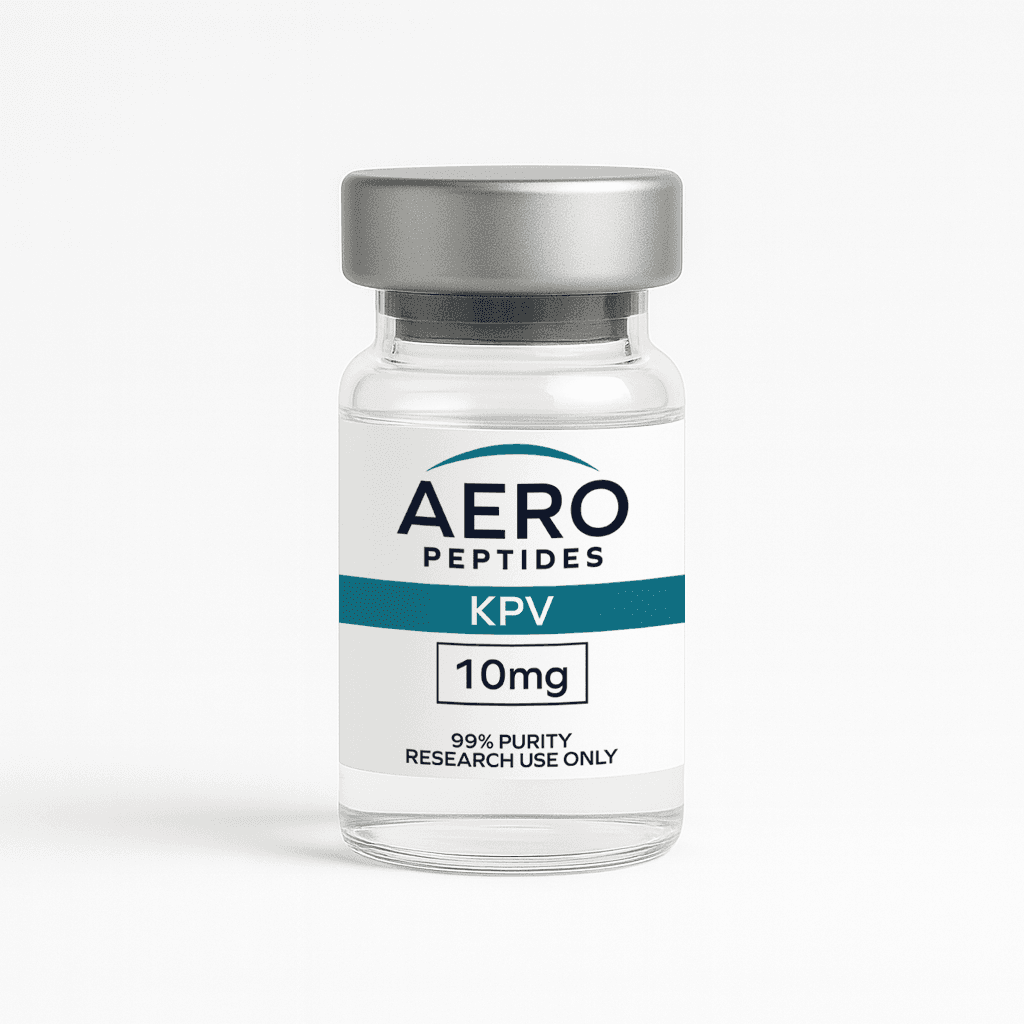
KPV is the C-terminal tripeptide fragment of alpha-melanocyte-stimulating hormone (α-MSH), comprising the lysine-proline-valine residues responsible for much of α-MSH's reported anti-inflammatory signature. Published in vitro and rodent-model studies have characterised its uptake via the PepT1 transporter and its interaction with NF-κB and MAP kinase pathways in models of intestinal, dermal, and mucosal inflammation. For laboratory and research use only.
Dosage
10MG$39.99
Bundle & Save
Discount applied automatically at checkout. Add 3+ for the best price per vial.
Quantity
Research focus
Summary of contexts in which this compound appears in the preclinical literature. See cited studies for primary sources.
KPV is the C-terminal tripeptide fragment of alpha-melanocyte-stimulating hormone (α-MSH), comprising the lysine-proline-valine residues responsible for much of α-MSH's reported anti-inflammatory signature. Published in vitro and rodent-model studies have characterised its uptake via the PepT1 transporter and its interaction with NF-κB and MAP kinase pathways in models of intestinal, dermal, and mucosal inflammation. For laboratory and research use only.
Areas of research interest
Technical specifications
Compound Information
Tripeptide (α-MSH C-terminal fragment)
Storage & Stability
Lyophilized (powder)
-20°C • long-term stable in sealed lyophilized form
Reconstituted
2-8°C • use within 30 days of reconstitution
Light
Protect from light during storage and reconstitution
Room temperature
Short-term tolerant during shipping; minimise extended exposure above 25°C
Compound-specific notes
Aqueous KPV solutions show limited stability in published HPLC characterisation work; reconstituted material should be kept refrigerated, protected from light, and used within the validated window.
Dosing in the literature
Observational summary of values reported in published research. Not a guide for human or animal use.
Reconstitution
KPV (342.44 g/mol) is highly water-soluble. Published in vitro work typically prepares stock solutions in phosphate-buffered saline or distilled water at 1–10 mM; a 10 mg vial dissolved in 1 mL bacteriostatic water yields approximately 29 mM stock. In vivo rodent studies used aqueous oral or intracolonic delivery vehicles.
Published protocols
In vitro keratinocyte and epithelial-cell studies used KPV at 10 nM – 10 µM (Elliott et al., J Invest Dermatol 2004; Mandrika et al., Peptides 2003). Murine IBD models administered 50–500 µg/mouse orally or intracolonically (Dalmasso et al., Gastroenterology 2008; Kannengiesser et al., IBD 2008). Nanoparticle-mediated oral delivery in colitis models was examined by Xiao et al. (Biomaterials 2017). No human RCT data are available; all published protocols are preclinical.
Half-life
KPV is a tripeptide subject to rapid peptidase degradation in plasma and gastrointestinal environments. No pharmacokinetic half-life measurement is reported in the cited papers. PepT1-mediated uptake characterised by Dalmasso et al. (Gastroenterology 2008) suggests intestinal absorption occurs intact at micromolar concentrations, but systemic half-life remains uncharacterised.
Post-reconstitution stability
Aqueous KPV solutions have shown limited stability in published HPLC characterisation work; the storage note on this file advises keeping reconstituted material refrigerated and protected from light, used within the validated window. No specific stability endpoint is reported in the cited literature.
In vitro concentrations from Elliott et al. (J Invest Dermatol 2004, PMID 15102092) and Mandrika et al. (Peptides 2003, PMID 12750433). In vivo dose ranges from Dalmasso et al. (Gastroenterology 2008, PMID 18061177) and Kannengiesser et al. (IBD 2008, PMID 18092346). Half-life not reported in cited references; general tripeptide PK literature cited as basis for instability note.
Sources & references
Gastroenterology
PepT1-mediated tripeptide KPV uptake reduces intestinal inflammation
Dalmasso G, Charrier-Hisamuddin L, Nguyen HT, Yan Y, Sitaraman S, Merlin D
2008 · DOI: 10.1053/j.gastro.2007.10.026 · PMID: 18061177
Read on PubMed ↗Inflammatory Bowel Diseases
Melanocortin-derived tripeptide KPV has anti-inflammatory potential in murine models of inflammatory bowel disease
Kannengiesser K, Maaser C, Heidemann J, et al.
2008 · DOI: 10.1002/ibd.20334 · PMID: 18092346
Read on PubMed ↗Journal of Investigative Dermatology
alpha-Melanocyte-stimulating hormone, MSH 11-13 KPV and adrenocorticotropic hormone signalling in human keratinocyte cells
Elliott RJ, Szabo M, Wagner MJ, et al.
2004 · DOI: 10.1111/j.0022-202X.2004.22404.x · PMID: 15102092
Read on PubMed ↗Annals of the New York Academy of Sciences
New insights into the functions of alpha-MSH and related peptides in the immune system
Luger TA, Scholzen TE, Brzoska T, et al.
2003 · DOI: 10.1111/j.1749-6632.2003.tb03172.x · PMID: 12851308
Read on PubMed ↗Biomaterials
Orally Targeted Delivery of Tripeptide KPV via Hyaluronic Acid-Functionalized Nanoparticles Efficiently Alleviates Ulcerative Colitis
Xiao B, Xu Z, Viennois E, et al.
2017 · DOI: 10.1016/j.biomaterials.2017.01.022 · PMID: 28143741
Read on PubMed ↗Peptides
Dissection of the anti-inflammatory effect of the core and C-terminal (KPV) alpha-melanocyte-stimulating hormone peptides
Mandrika I, Muceniece R, Wikberg JE
2003 · DOI: 10.1016/s0196-9781(03)00115-7 · PMID: 12750433
Read on PubMed ↗Journal of Leukocyte Biology
Antimicrobial effects of alpha-MSH peptides
Cutuli M, Cristiani S, Lipton JM, Catania A
1999 · DOI: 10.1002/jlb.66.6.1061 · PMID: 10670585
Read on PubMed ↗British Journal of Pharmacology
Terminal signal: anti-inflammatory effects of α-melanocyte-stimulating hormone related peptides beyond the pharmacophore
Brzoska T, Böhm M, Lügering A, Loser K, Luger TA
2011 · DOI: 10.1111/j.1476-5381.2010.01205.x · PMID: 21222263
Read on PubMed ↗Oncotarget
Critical role of PepT1 in promoting colitis-associated cancer and therapeutic benefits of the anti-inflammatory PepT1-mediated tripeptide KPV in a murine model
Viennois E, Pujada A, Sung J, et al.
2016 · DOI: 10.18632/oncotarget.10822 · PMID: 27458604
Read on PubMed ↗9 peer-reviewed references listed. Citations verified against NCBI PubMed records. For research and educational reference only — does not constitute medical advice.
Researcher FAQ
No. Aero Peptides materials are sold exclusively for in-vitro research and laboratory analytical use. They are not intended to diagnose, treat, cure, or prevent any disease, and are not approved for human or animal administration.
By placing an order, you confirm that you are a qualified researcher and that the material will be used in accordance with all applicable institutional and jurisdictional regulations.
Each lot is independently tested for identity, purity, and mass using HPLC and mass spectrometry. The COA lists the lot number, test date, assay results, and the laboratory that performed the analysis.
Public COA documents are being prepared. In the meantime, you can request a COA for your specific lot and we’ll email it within 1 business day.
Orders ship quickly after your order is placed, from the US. Lyophilized peptides are shipped with insulation appropriate to season; short-term ambient excursions during transit do not measurably affect potency.
On receipt, store at −20°C in the sealed vial until reconstitution. See the handling matrix for full storage parameters. Tracked shipping is included; we ship to all US states and most international destinations.
Most peptides are reconstituted with bacteriostatic water (BAC). The volume depends on the target working concentration. Use our Peptide Calculator to compute volume, U-100 insulin syringe units, and doses per vial from peptide mass and target dose.
Once reconstituted, store at 2–8°C and use within 30 days. Protect the vial from light during storage and handling.
Because peptides are temperature-sensitive research materials, we cannot accept returns of opened or unsealed vials. If a shipment arrives damaged or the seal is broken on arrival, contact us within 7 days and we’ll replace or refund.
See our full returns policy for details.
Don’t see your question? Contact our research team — we typically reply within one business day.
In the same category
Frequently paired
⚠ Important research notice
Not for human consumption. This product is sold exclusively for research and educational purposes. It is not intended to diagnose, treat, cure, or prevent any disease.
All clinical trial data and research findings presented on this page are sourced from peer-reviewed journals and official publications. They are provided for educational reference only and should not be interpreted as medical advice or product claims.
By purchasing this product, you confirm that you are a qualified researcher and will use it in accordance with all applicable laws and regulations.