Journal of Nutrition
Glutathione metabolism and its implications for health
Wu G, Fang YZ, Yang S, et al.
2004 · DOI: 10.1093/jn/134.3.489 · PMID: 14988435
Read on PubMed ↗
Researcher attestation
Aero Peptides supplies research-grade peptides for in-vitro and laboratory use only. Not for human or veterinary consumption.
By entering you confirm that:
Acceptance stored locally for 180 days.
Free US shipping over $150Free domestic shipping on all orders over $150
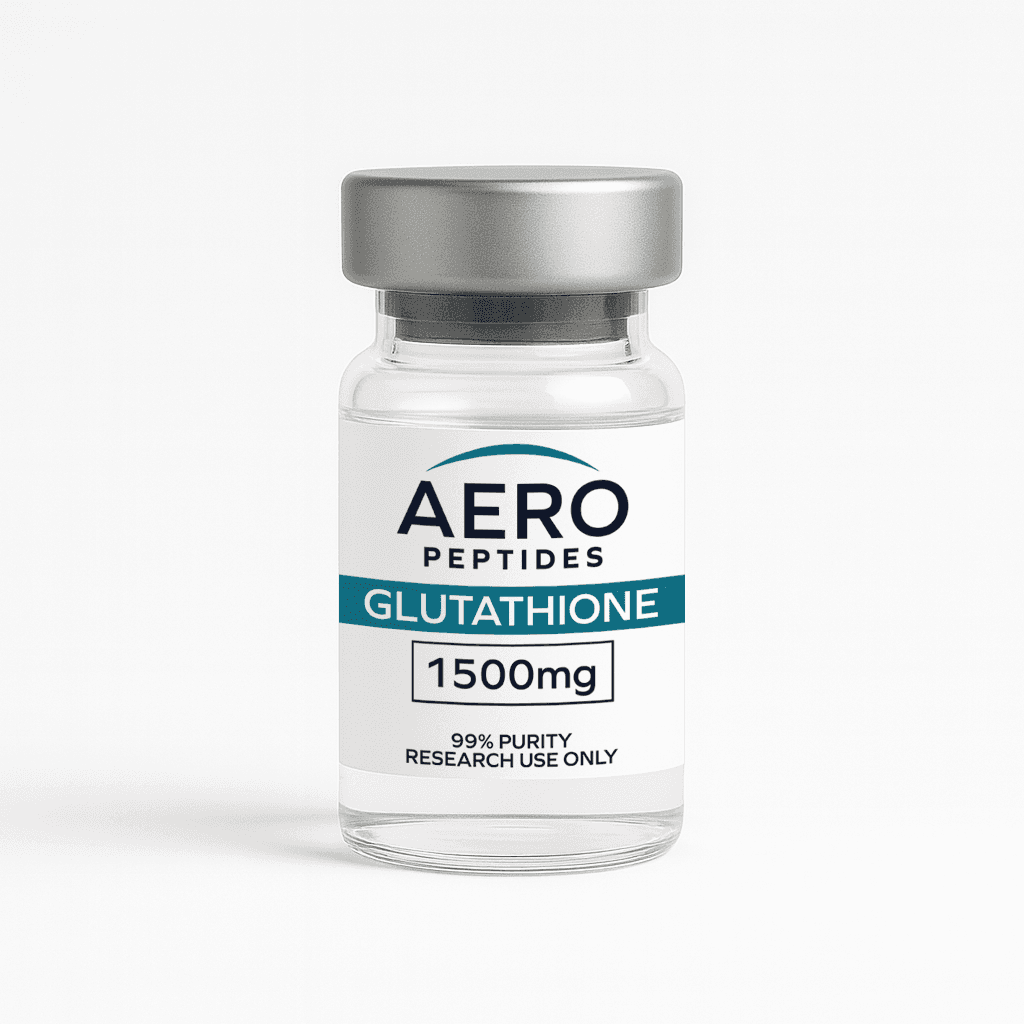
Cellular Health & Longevity
Glutathione (GSH) is an endogenous tripeptide thiol composed of L-glutamate, L-cysteine, and glycine joined by an unusual γ-glutamyl peptide bond, and is the principal intracellular non-protein antioxidant in mammalian cells. Decades of peer-reviewed literature have characterised its role in redox homeostasis, glutathione-S-transferase-mediated xenobiotic conjugation, reactive-oxygen and reactive-nitrogen species buffering, hepatic detoxification biology, and protein S-glutathionylation as a redox-signalling post-translational modification. For laboratory and research use only.
Research focus
Summary of contexts in which this compound appears in the preclinical literature. See cited studies for primary sources.
Glutathione (GSH) is an endogenous tripeptide thiol composed of L-glutamate, L-cysteine, and glycine joined by an unusual γ-glutamyl peptide bond, and is the principal intracellular non-protein antioxidant in mammalian cells. Decades of peer-reviewed literature have characterised its role in redox homeostasis, glutathione-S-transferase-mediated xenobiotic conjugation, reactive-oxygen and reactive-nitrogen species buffering, hepatic detoxification biology, and protein S-glutathionylation as a redox-signalling post-translational modification. For laboratory and research use only.
Areas of research interest
Technical specifications
Compound Information
Endogenous tripeptide thiol (antioxidant cofactor)
Storage & Stability
Lyophilized (powder)
-20°C • long-term stable in sealed lyophilized form
Reconstituted
2-8°C • use within 30 days of reconstitution
Light
Protect from light during storage and reconstitution
Room temperature
Short-term tolerant during shipping; minimise extended exposure above 25°C
Compound-specific notes
The free cysteinyl thiol oxidises readily in aqueous solution to the disulfide form (GSSG); minimise air exposure, keep reconstituted material sealed under low headspace, and consider degassed diluent when the experimental endpoint depends on the GSH/GSSG redox ratio.
Dosing in the literature
Observational summary of values reported in published research. Not a guide for human or animal use.
Reconstitution
Typically 3–5 mL sterile or bacteriostatic water per 1500 mg vial, yielding a 300–500 mg/mL working concentration. The free thiol dissolves readily in aqueous solution; minimise headspace and avoid prolonged exposure to air during reconstitution.
Published protocols
IV glutathione infusion doses in published hepatic and oxidative-stress research have ranged widely (600 mg to several grams per session) depending on model context. Wu et al. (J Nutrition, 2004) and Lu (BBA, 2013) characterise GSH biosynthesis and metabolism biology rather than parenteral dosing schedules; Forman, Zhang & Rinna (Mol Aspects Med, 2009) review measurement and protective roles without establishing standard infusion protocols.
Half-life
Circulating GSH half-life is short — reported in the range of minutes in plasma due to rapid uptake by tissues and catabolic turnover via γ-glutamyl transpeptidase; this pharmacokinetic feature is discussed in the context of cellular homeostasis by Wu et al. (2004) and Forman et al. (2009) rather than as a parameter for exogenous dosing.
Post-reconstitution stability
Substantially shorter than typical peptide preparations. The free cysteinyl thiol oxidises to GSSG in aqueous solution, particularly under aerobic conditions; degrade rate accelerates at room temperature. Reconstituted material should be used promptly; sealed under low headspace at 2–8 °C for short-term storage only.
Parenteral PK and stability values are derived from general GSH biochemistry literature (Wu et al. 2004; Lu 2013; Forman et al. 2009) and are not sourced from SKU-specific stability studies. The cited publications do not establish standard parenteral research protocols; thiol oxidation sensitivity flagged from known chemical properties of the GSH/GSSG redox couple.
Sources & references
Journal of Nutrition
Glutathione metabolism and its implications for health
Wu G, Fang YZ, Yang S, et al.
2004 · DOI: 10.1093/jn/134.3.489 · PMID: 14988435
Read on PubMed ↗Biochimica et Biophysica Acta
Glutathione synthesis
Lu SC
2013 · DOI: 10.1016/j.bbagen.2012.09.008 · PMID: 22995213
Read on PubMed ↗Molecular Aspects of Medicine
Glutathione: overview of its protective roles, measurement, and biosynthesis
Forman HJ, Zhang H, Rinna A
2009 · DOI: 10.1016/j.mam.2008.08.006 · PMID: 18796312
Read on PubMed ↗Molecular Aspects of Medicine
Glutathione in liver diseases and hepatotoxicity
Yuan L, Kaplowitz N
2009 · DOI: 10.1016/j.mam.2008.08.003 · PMID: 18786561
Read on PubMed ↗American Journal of Physiology - Cell Physiology
Radical-free biology of oxidative stress
Jones DP
2008 · DOI: 10.1152/ajpcell.00283.2008 · PMID: 18684987
Read on PubMed ↗Biochemical Journal
How mitochondria produce reactive oxygen species
Murphy MP
2009 · DOI: 10.1042/BJ20081386 · PMID: 19061483
Read on PubMed ↗Biochimica et Biophysica Acta
Glutathione and infection
Morris D, Khurasany M, Nguyen T, et al.
2013 · DOI: 10.1016/j.bbagen.2012.10.012 · PMID: 23089304
Read on PubMed ↗Biomolecules
Oxidative stress in aging human skin
Rinnerthaler M, Bischof J, Streubel MK, et al.
2015 · DOI: 10.3390/biom5020545 · PMID: 25906193
Read on PubMed ↗8 peer-reviewed references listed. Citations verified against NCBI PubMed records. For research and educational reference only — does not constitute medical advice.
Researcher FAQ
No. Aero Peptides materials are sold exclusively for in-vitro research and laboratory analytical use. They are not intended to diagnose, treat, cure, or prevent any disease, and are not approved for human or animal administration.
By placing an order, you confirm that you are a qualified researcher and that the material will be used in accordance with all applicable institutional and jurisdictional regulations.
Each lot is independently tested for identity, purity, and mass using HPLC and mass spectrometry. The COA lists the lot number, test date, assay results, and the laboratory that performed the analysis.
Public COA documents are being prepared. In the meantime, you can request a COA for your specific lot and we’ll email it within 1 business day.
Orders ship quickly after your order is placed, from the US. Lyophilized peptides are shipped with insulation appropriate to season; short-term ambient excursions during transit do not measurably affect potency.
On receipt, store at −20°C in the sealed vial until reconstitution. See the handling matrix for full storage parameters. Tracked shipping is included; we ship to all US states and most international destinations.
Most peptides are reconstituted with bacteriostatic water (BAC). The volume depends on the target working concentration. Use our Peptide Calculator to compute volume, U-100 insulin syringe units, and doses per vial from peptide mass and target dose.
Once reconstituted, store at 2–8°C and use within 30 days. Protect the vial from light during storage and handling.
Because peptides are temperature-sensitive research materials, we cannot accept returns of opened or unsealed vials. If a shipment arrives damaged or the seal is broken on arrival, contact us within 7 days and we’ll replace or refund.
See our full returns policy for details.
Don’t see your question? Contact our research team — we typically reply within one business day.
In the same category
Frequently paired
⚠ Important research notice
Not for human consumption. This product is sold exclusively for research and educational purposes. It is not intended to diagnose, treat, cure, or prevent any disease.
All clinical trial data and research findings presented on this page are sourced from peer-reviewed journals and official publications. They are provided for educational reference only and should not be interpreted as medical advice or product claims.
By purchasing this product, you confirm that you are a qualified researcher and will use it in accordance with all applicable laws and regulations.