Cell Metabolism
The mitochondrial-derived peptide MOTS-c promotes metabolic homeostasis and reduces obesity and insulin resistance
Lee C, Zeng J, Drew BG, et al.
2015 · DOI: 10.1016/j.cmet.2015.02.009 · PMID: 25738459
Read on PubMed ↗
Researcher attestation
Aero Peptides supplies research-grade peptides for in-vitro and laboratory use only. Not for human or veterinary consumption.
By entering you confirm that:
Acceptance stored locally for 180 days.
Free US shipping over $150Free domestic shipping on all orders over $150
Cellular Health & Longevity
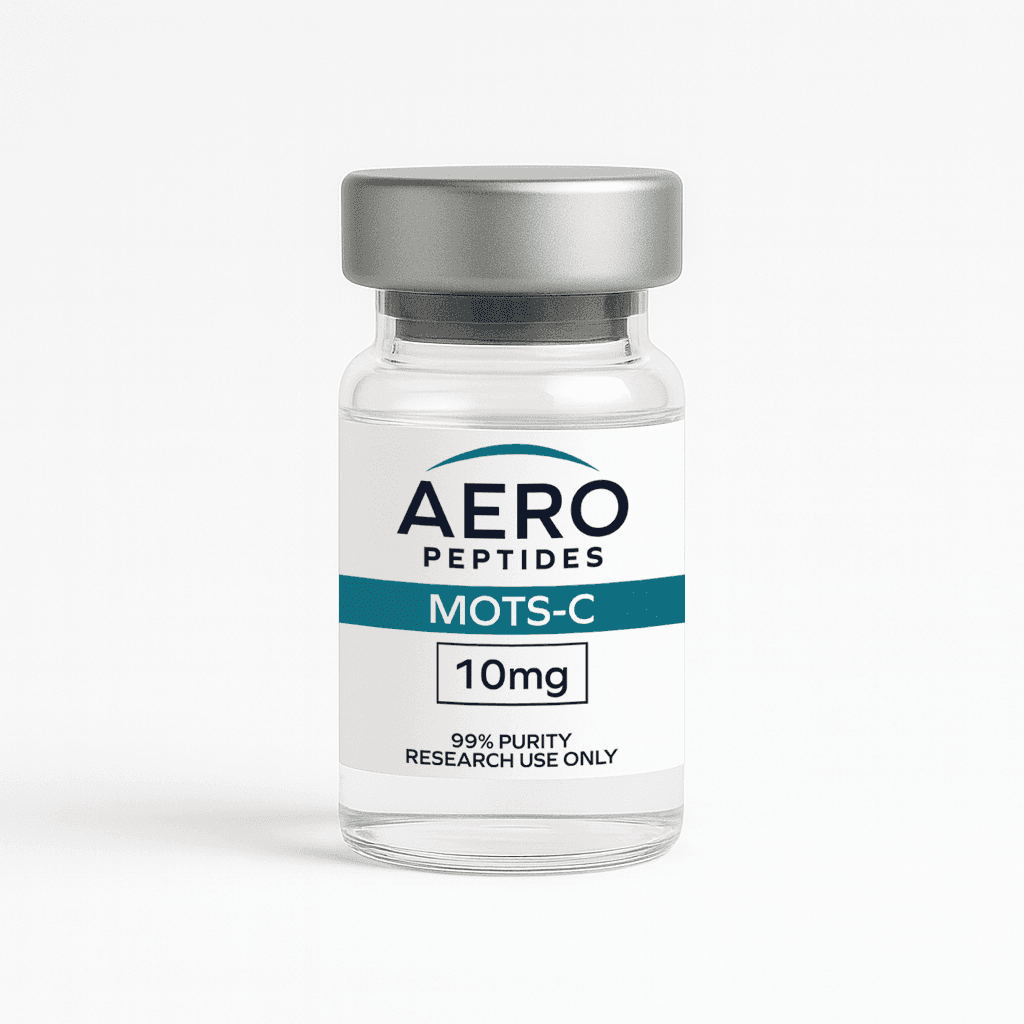
MOTS-c is a 16-amino-acid mitochondrial-derived peptide encoded within the short open reading frame of the 12S rRNA region of the mitochondrial genome. Published in vitro and animal-model studies have characterised its interaction with AMPK signalling, the folate-AICAR axis, and metabolic-homeostasis pathways, with reported nuclear translocation under metabolic stress. For laboratory and research use only.
Dosage
10MG$39.99
Bundle & Save
Discount applied automatically at checkout. Add 3+ for the best price per vial.
Quantity
Research focus
Summary of contexts in which this compound appears in the preclinical literature. See cited studies for primary sources.
MOTS-c is a 16-amino-acid mitochondrial-derived peptide encoded within the short open reading frame of the 12S rRNA region of the mitochondrial genome. Published in vitro and animal-model studies have characterised its interaction with AMPK signalling, the folate-AICAR axis, and metabolic-homeostasis pathways, with reported nuclear translocation under metabolic stress. For laboratory and research use only.
Areas of research interest
Technical specifications
Compound Information
Mitochondrial-derived peptide (16 amino acids)
Storage & Stability
Lyophilized (powder)
-20°C • long-term stable in sealed lyophilized form
Reconstituted
2-8°C • use within 30 days of reconstitution
Light
Protect from light during storage and reconstitution
Room temperature
Short-term tolerant during shipping; minimise extended exposure above 25°C
Compound-specific notes
Contains methionine and tryptophan residues sensitive to oxidation; minimise air exposure and freeze-thaw cycles during research handling to preserve sequence integrity.
Dosing in the literature
Observational summary of values reported in published research. Not a guide for human or animal use.
Reconstitution
Typically 1–2 mL bacteriostatic water per 10 mg vial, yielding ~5–10 mg/mL working concentration. The 16-amino-acid sequence is hydrophilic; dissolves readily in aqueous diluent with gentle agitation.
Published protocols
Published research is predominantly preclinical. Lee et al. (Cell Metabolism, 2015) administered MOTS-c via IP injection in mouse metabolic models; Reynolds et al. (Nature Communications, 2021) used SC injection in aged mouse exercise studies. Kim et al. (Aging Cell, 2019) reported plasma metabolite effects in mouse models. No standardised human parenteral protocol is established in the cited literature.
Half-life
Precise plasma half-life in humans is not established in the cited literature. Preclinical animal-model studies (Lee et al. 2015; Reynolds et al. 2021) characterise pharmacodynamic endpoints rather than PK parameters; the 16-residue sequence lacks the structural modifications that extend half-life in engineered analogues.
Post-reconstitution stability
~28 days at 2–8 °C in BAC-water solution under standard peptide handling. Contains methionine and tryptophan residues sensitive to oxidation; minimise freeze-thaw cycles and air exposure as noted in storage specification.
Reconstitution and stability values extrapolated from general small-peptide PK conventions; no MOTS-c–specific stability studies are cited. Dosing values drawn from Lee et al. (Cell Metabolism, 2015), Reynolds et al. (Nature Communications, 2021), and Kim et al. (Aging Cell, 2019) — all rodent preclinical work. Human data are absent from the cited literature.
Sources & references
Cell Metabolism
The mitochondrial-derived peptide MOTS-c promotes metabolic homeostasis and reduces obesity and insulin resistance
Lee C, Zeng J, Drew BG, et al.
2015 · DOI: 10.1016/j.cmet.2015.02.009 · PMID: 25738459
Read on PubMed ↗Cell Metabolism
The Mitochondrial-Encoded Peptide MOTS-c Translocates to the Nucleus to Regulate Nuclear Gene Expression in Response to Metabolic Stress
Kim KH, Son JM, Benayoun BA, et al.
2018 · DOI: 10.1016/j.cmet.2018.06.008 · PMID: 29983246
Read on PubMed ↗Free Radical Biology and Medicine
MOTS-c: A novel mitochondrial-derived peptide regulating muscle and fat metabolism
Lee C, Kim KH, Cohen P
2016 · DOI: 10.1016/j.freeradbiomed.2016.05.015 · PMID: 27216708
Read on PubMed ↗Nature Communications
MOTS-c is an exercise-induced mitochondrial-encoded regulator of age-dependent physical decline and muscle homeostasis
Reynolds JC, Lai RW, Woodhead JST, et al.
2021 · DOI: 10.1038/s41467-020-20790-0 · PMID: 33473109
Read on PubMed ↗Aging Cell
The mitochondrial-derived peptide MOTS-c is a regulator of plasma metabolites and enhances insulin sensitivity
Kim SJ, Miller B, Mehta HH, et al.
2019 · DOI: 10.14814/phy2.14171 · PMID: 31293078
Read on PubMed ↗Molecular Metabolism
MOTS-c interacts synergistically with exercise intervention to regulate PGC-1α expression, attenuate insulin resistance and enhance glucose metabolism in mice via AMPK signaling pathway
Yang B, Yu Q, Chang B, et al.
2021 · DOI: 10.1016/j.bbadis.2021.166126 · PMID: 33722744
Read on PubMed ↗Biochemical and Biophysical Research Communications
MOTS-c improves osteoporosis by promoting osteogenic differentiation of bone marrow mesenchymal stem cells via TGF-β/Smad pathway
Hu BT, Chen WZ
2019 · DOI: 10.1016/j.bbrc.2018.11.078 · PMID: 30468456
Read on PubMed ↗Frontiers in Physiology
Mitochondria-derived peptide MOTS-c: effects and mechanisms related to stress, metabolism and aging
Wan W, Zhang L, Lin Y, et al.
2023 · DOI: 10.1186/s12967-023-03885-2 · PMID: 36670507
Read on PubMed ↗8 peer-reviewed references listed. Citations verified against NCBI PubMed records. For research and educational reference only — does not constitute medical advice.
Researcher FAQ
No. Aero Peptides materials are sold exclusively for in-vitro research and laboratory analytical use. They are not intended to diagnose, treat, cure, or prevent any disease, and are not approved for human or animal administration.
By placing an order, you confirm that you are a qualified researcher and that the material will be used in accordance with all applicable institutional and jurisdictional regulations.
Each lot is independently tested for identity, purity, and mass using HPLC and mass spectrometry. The COA lists the lot number, test date, assay results, and the laboratory that performed the analysis.
Public COA documents are being prepared. In the meantime, you can request a COA for your specific lot and we’ll email it within 1 business day.
Orders ship quickly after your order is placed, from the US. Lyophilized peptides are shipped with insulation appropriate to season; short-term ambient excursions during transit do not measurably affect potency.
On receipt, store at −20°C in the sealed vial until reconstitution. See the handling matrix for full storage parameters. Tracked shipping is included; we ship to all US states and most international destinations.
Most peptides are reconstituted with bacteriostatic water (BAC). The volume depends on the target working concentration. Use our Peptide Calculator to compute volume, U-100 insulin syringe units, and doses per vial from peptide mass and target dose.
Once reconstituted, store at 2–8°C and use within 30 days. Protect the vial from light during storage and handling.
Because peptides are temperature-sensitive research materials, we cannot accept returns of opened or unsealed vials. If a shipment arrives damaged or the seal is broken on arrival, contact us within 7 days and we’ll replace or refund.
See our full returns policy for details.
Don’t see your question? Contact our research team — we typically reply within one business day.
In the same category
Frequently paired
⚠ Important research notice
Not for human consumption. This product is sold exclusively for research and educational purposes. It is not intended to diagnose, treat, cure, or prevent any disease.
All clinical trial data and research findings presented on this page are sourced from peer-reviewed journals and official publications. They are provided for educational reference only and should not be interpreted as medical advice or product claims.
By purchasing this product, you confirm that you are a qualified researcher and will use it in accordance with all applicable laws and regulations.