Science
NAD+ in aging, metabolism, and neurodegeneration
Verdin E
2015 · DOI: 10.1126/science.aac4854 · PMID: 26785480
Read on PubMed ↗
Researcher attestation
Aero Peptides supplies research-grade peptides for in-vitro and laboratory use only. Not for human or veterinary consumption.
By entering you confirm that:
Acceptance stored locally for 180 days.
Free US shipping over $150Free domestic shipping on all orders over $150
Cellular Health & Longevity
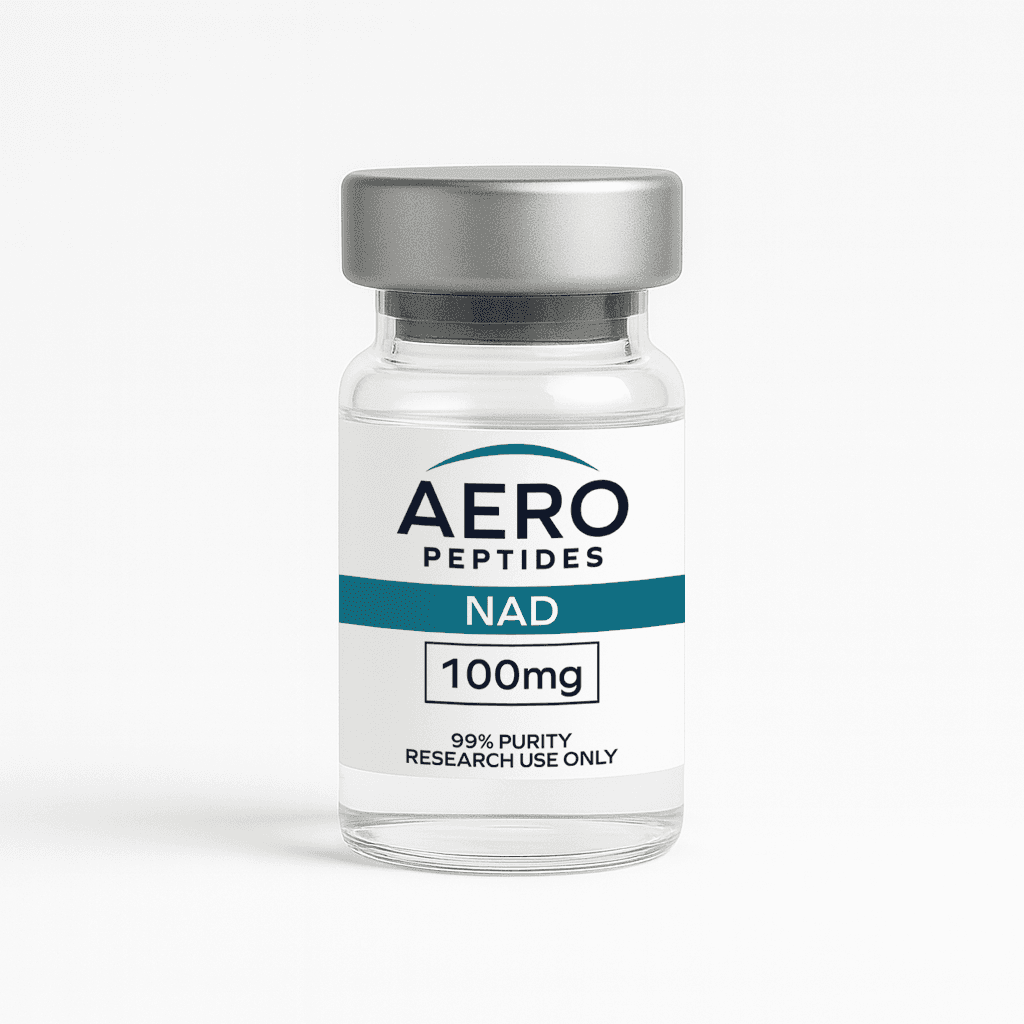
NAD+ (nicotinamide adenine dinucleotide) is an endogenous pyridine-nucleotide coenzyme central to cellular redox biology and a required substrate for the sirtuin, PARP, and CD38 enzyme families. A substantial research literature has characterised its role in mitochondrial bioenergetics, DNA-damage signalling, and age-associated metabolic pathways, with preclinical models examining how cellular NAD+ pools change across tissue and lifespan. For laboratory and research use only.
Research focus
Summary of contexts in which this compound appears in the preclinical literature. See cited studies for primary sources.
NAD+ (nicotinamide adenine dinucleotide) is an endogenous pyridine-nucleotide coenzyme central to cellular redox biology and a required substrate for the sirtuin, PARP, and CD38 enzyme families. A substantial research literature has characterised its role in mitochondrial bioenergetics, DNA-damage signalling, and age-associated metabolic pathways, with preclinical models examining how cellular NAD+ pools change across tissue and lifespan. For laboratory and research use only.
Areas of research interest
Technical specifications
Compound Information
Pyridine nucleotide coenzyme
Storage & Stability
Lyophilized (powder)
-20°C • long-term stable in sealed lyophilized form
Reconstituted
2-8°C • use within 14 days of reconstitution (shorter than typical peptide window)
Light
Photosensitive — protect from light during storage and reconstitution; the nicotinamide moiety is reported to degrade on UV exposure
Room temperature
Short-term tolerant during shipping; minimise extended exposure above 25°C
Compound-specific notes
Distinct from peptide compounds: NAD+ is a small-molecule dinucleotide that undergoes hydrolysis in aqueous solution more rapidly than most peptides, and is reported to be hygroscopic. Reconstitute close to time of use and minimise freeze-thaw cycles.
Dosing in the literature
Observational summary of values reported in published research. Not a guide for human or animal use.
Reconstitution
Typically 3–5 mL sterile or bacteriostatic water per 100 mg vial, yielding a 20–33 mg/mL working concentration. Aqueous solubility is high; vortex gently until fully dissolved.
Published protocols
No standardised parenteral research protocol exists for exogenous NAD+ administration. Rajman et al. (Cell Metabolism, 2018) reviewed preclinical NMN/NR supplementation studies; Guarente, Sinclair & Kroemer (Cell Metabolism, 2024) noted that human trials have used oral NMN and NR precursors rather than direct NAD+ parenteral dosing. Published IV NAD+ infusion work is limited to small clinical reports and addiction-medicine contexts not represented in the cited literature.
Half-life
NAD+ half-life in circulating blood is short (minutes to low hours) due to rapid tissue uptake and enzymatic cycling; precise parenteral pharmacokinetic parameters are not established in the cited literature. Verdin (Science, 2015) and Gomes et al. (Cell, 2013) describe tissue NAD+ dynamics in the context of aging and metabolic stress rather than exogenous infusion kinetics.
Post-reconstitution stability
~14 days at 2–8 °C as noted in storage specification; shorter than typical peptides. NAD+ undergoes hydrolysis in aqueous solution and is hygroscopic — reconstitute close to time of use.
Reconstitution and stability values from general NAD+ biochemistry; no SKU-specific stability studies cited. Parenteral PK values are absent from the cited Verdin, Rajman, Zhang, Yoshino, Cantó, Gomes, Chini, and Guarente publications, which focus on cellular and preclinical contexts rather than exogenous infusion pharmacokinetics.
Sources & references
Science
NAD+ in aging, metabolism, and neurodegeneration
Verdin E
2015 · DOI: 10.1126/science.aac4854 · PMID: 26785480
Read on PubMed ↗Cell Metabolism
Therapeutic Potential of NAD-Boosting Molecules: The In Vivo Evidence
Rajman L, Chwalek K, Sinclair DA
2018 · DOI: 10.1016/j.cmet.2018.02.011 · PMID: 29514064
Read on PubMed ↗Science
NAD+ repletion improves mitochondrial and stem cell function and enhances life span in mice
Zhang H, Ryu D, Wu Y, et al.
2016 · DOI: 10.1126/science.aaf2693 · PMID: 27127236
Read on PubMed ↗Cell Metabolism
NAD+ Intermediates: The Biology and Therapeutic Potential of NMN and NR
Yoshino J, Baur JA, Imai S
2018 · DOI: 10.1016/j.cmet.2017.11.002 · PMID: 29249689
Read on PubMed ↗Cell Metabolism
The NAD(+) precursor nicotinamide riboside enhances oxidative metabolism and protects against high-fat diet-induced obesity
Cantó C, Houtkooper RH, Pirinen E, et al.
2012 · DOI: 10.1016/j.cmet.2012.04.022 · PMID: 22682224
Read on PubMed ↗Cell
Declining NAD+ induces a pseudohypoxic state disrupting nuclear-mitochondrial communication during aging
Gomes AP, Price NL, Ling AJY, et al.
2013 · DOI: 10.1016/j.cell.2013.11.037 · PMID: 24360282
Read on PubMed ↗Nature Metabolism
CD38 ecto-enzyme in immune cells is induced during aging and regulates NAD+ and NMN levels
Chini CCS, Peclat TR, Warner GM, et al.
2020 · DOI: 10.1038/s42255-020-00298-z · PMID: 33199925
Read on PubMed ↗Cell Metabolism
Human trials exploring anti-aging medicines
Guarente L, Sinclair DA, Kroemer G
2024 · DOI: 10.1016/j.cmet.2023.12.007 · PMID: 38181790
Read on PubMed ↗8 peer-reviewed references listed. Citations verified against NCBI PubMed records. For research and educational reference only — does not constitute medical advice.
Researcher FAQ
No. Aero Peptides materials are sold exclusively for in-vitro research and laboratory analytical use. They are not intended to diagnose, treat, cure, or prevent any disease, and are not approved for human or animal administration.
By placing an order, you confirm that you are a qualified researcher and that the material will be used in accordance with all applicable institutional and jurisdictional regulations.
Each lot is independently tested for identity, purity, and mass using HPLC and mass spectrometry. The COA lists the lot number, test date, assay results, and the laboratory that performed the analysis.
Public COA documents are being prepared. In the meantime, you can request a COA for your specific lot and we’ll email it within 1 business day.
Orders ship quickly after your order is placed, from the US. Lyophilized peptides are shipped with insulation appropriate to season; short-term ambient excursions during transit do not measurably affect potency.
On receipt, store at −20°C in the sealed vial until reconstitution. See the handling matrix for full storage parameters. Tracked shipping is included; we ship to all US states and most international destinations.
Most peptides are reconstituted with bacteriostatic water (BAC). The volume depends on the target working concentration. Use our Peptide Calculator to compute volume, U-100 insulin syringe units, and doses per vial from peptide mass and target dose.
Once reconstituted, store at 2–8°C and use within 30 days. Protect the vial from light during storage and handling.
Because peptides are temperature-sensitive research materials, we cannot accept returns of opened or unsealed vials. If a shipment arrives damaged or the seal is broken on arrival, contact us within 7 days and we’ll replace or refund.
See our full returns policy for details.
Don’t see your question? Contact our research team — we typically reply within one business day.
In the same category
Frequently paired
⚠ Important research notice
Not for human consumption. This product is sold exclusively for research and educational purposes. It is not intended to diagnose, treat, cure, or prevent any disease.
All clinical trial data and research findings presented on this page are sourced from peer-reviewed journals and official publications. They are provided for educational reference only and should not be interpreted as medical advice or product claims.
By purchasing this product, you confirm that you are a qualified researcher and will use it in accordance with all applicable laws and regulations.