New England Journal of Medicine
Afamelanotide for Erythropoietic Protoporphyria
Langendonk JG, Balwani M, Anderson KE, et al.
2015 · DOI: 10.1056/NEJMoa1411481 · PMID: 26132941
Read on PubMed ↗
Researcher attestation
Aero Peptides supplies research-grade peptides for in-vitro and laboratory use only. Not for human or veterinary consumption.
By entering you confirm that:
Acceptance stored locally for 180 days.
Free US shipping over $150Free domestic shipping on all orders over $150
Skin, Hair & Cosmetic
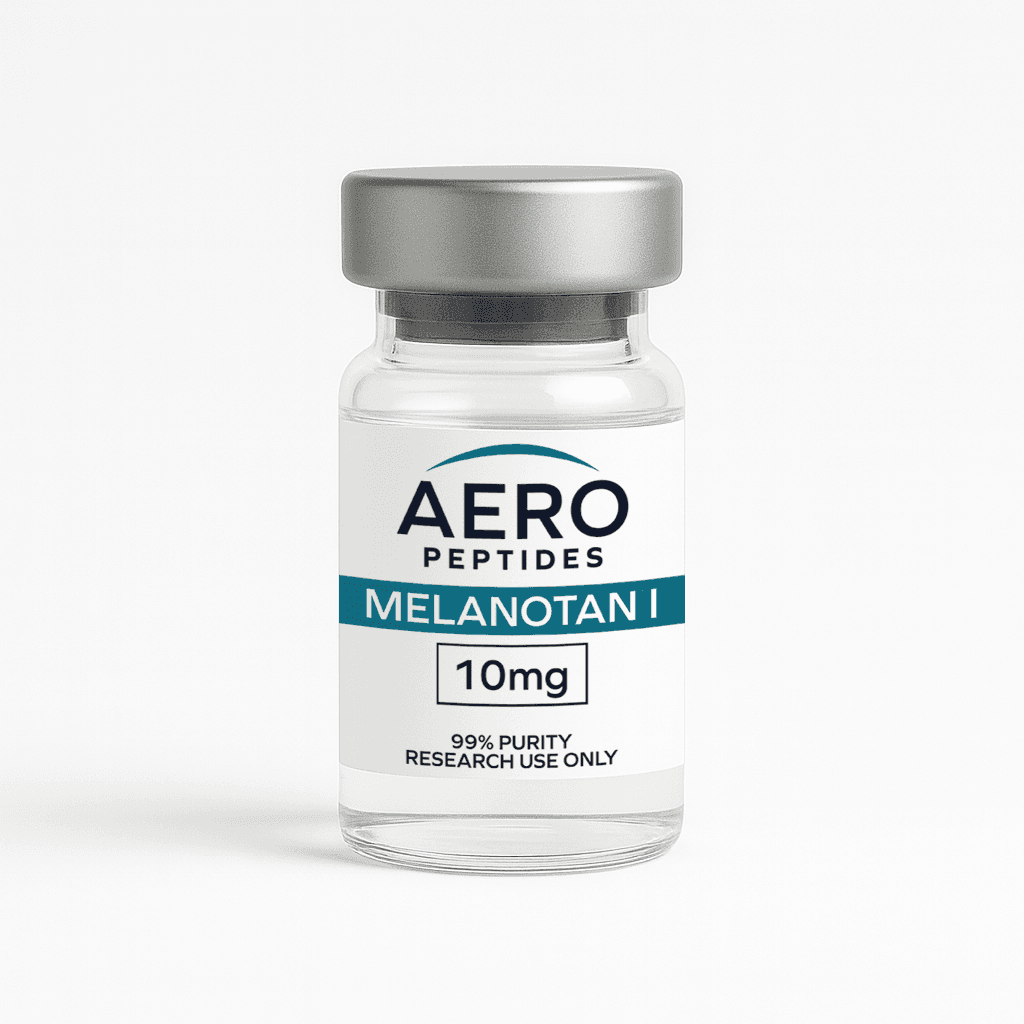
Melanotan-I (afamelanotide) is a synthetic 13-amino-acid analogue of alpha-melanocyte-stimulating hormone (α-MSH), with norleucine at position 4 and D-phenylalanine at position 7. These substitutions confer resistance to enzymatic degradation and prolonged binding at the melanocortin-1 receptor (MC1R) relative to the native hormone. The peptide has been characterised in preclinical and clinical literature exploring MC1R signalling, eumelanin biosynthesis, and pigmentation pathway models. For laboratory and research use only.
Dosage
10MG$24.99
Bundle & Save
Discount applied automatically at checkout. Add 3+ for the best price per vial.
Quantity
Research focus
Summary of contexts in which this compound appears in the preclinical literature. See cited studies for primary sources.
Melanotan-I (afamelanotide) is a synthetic 13-amino-acid analogue of alpha-melanocyte-stimulating hormone (α-MSH), with norleucine at position 4 and D-phenylalanine at position 7. These substitutions confer resistance to enzymatic degradation and prolonged binding at the melanocortin-1 receptor (MC1R) relative to the native hormone. The peptide has been characterised in preclinical and clinical literature exploring MC1R signalling, eumelanin biosynthesis, and pigmentation pathway models. For laboratory and research use only.
Areas of research interest
Technical specifications
Compound Information
Linear synthetic α-MSH analogue (tridecapeptide)
Storage & Stability
Lyophilized (powder)
-20°C • long-term stable in sealed lyophilized form
Reconstituted
2-8°C • use within 30 days of reconstitution
Light
Protect from light during storage and reconstitution
Room temperature
Short-term tolerant during shipping; minimise extended exposure above 25°C
Compound-specific notes
Reported in published work to resist serum-enzyme degradation that rapidly inactivates native α-MSH; standard peptide handling still applies for reconstituted material.
Dosing in the literature
Observational summary of values reported in published research. Not a guide for human or animal use.
Reconstitution
Typically 1–2 mL bacteriostatic water per 10 mg vial, yielding ~5–10 mg/mL working concentration. The linear tridecapeptide dissolves readily in aqueous diluent.
Published protocols
EMA-approved Scenesse (afamelanotide 16 mg) is administered as a SC implant every 60 days for EPP. Langendonk et al. (NEJM, 2015) used 16 mg SC implants in the pivotal EPP trial; Lim et al. (JAMA Dermatology, 2015) used 16 mg implants in the vitiligo + narrowband-UVB combination study; Biolcati et al. (BJD, 2015) reported the same implant dose in long-term EPP observational data. Dorr et al. (J Invest Dermatol, 2006) used SC injection of soluble [Nle4, D-Phe7]-α-MSH in a melanin-synthesis study.
Half-life
Terminal half-life of ~37 hours reported for the SC implant formulation in EMA review documentation, consistent with the prolonged activity noted by Sawyer et al. (PNAS, 1980). The Nle4 and D-Phe7 substitutions confer resistance to enzymatic degradation as characterised by Marwan et al. (Biochemistry, 1986).
Post-reconstitution stability
~28 days at 2–8 °C in BAC-water solution under standard peptide handling. The Nle4/D-Phe7 substitutions improve serum stability relative to native α-MSH per the cited literature.
Protocol doses and half-life from Langendonk et al. (NEJM, 2015), Lim et al. (JAMA Dermatology, 2015), Biolcati et al. (BJD, 2015), Sawyer et al. (PNAS, 1980), and Marwan et al. (Biochemistry, 1986). Clinical doses reflect the approved Scenesse implant device, not soluble vial preparations. Habbema et al. (Int J Dermatology, 2017) detail risks of unregulated use.
Sources & references
New England Journal of Medicine
Afamelanotide for Erythropoietic Protoporphyria
Langendonk JG, Balwani M, Anderson KE, et al.
2015 · DOI: 10.1056/NEJMoa1411481 · PMID: 26132941
Read on PubMed ↗Proceedings of the National Academy of Sciences USA
4-Norleucine, 7-D-phenylalanine-α-melanocyte-stimulating hormone: a highly potent α-melanotropin with ultralong biological activity
Sawyer TK, Sanfilippo PJ, Hruby VJ, Engel MH, Heward CB, Burnett JB, Hadley ME
1980 · DOI: 10.1073/pnas.77.10.5754 · PMID: 6777774
Read on PubMed ↗Biochemistry
[Nle4, D-Phe7]-α-MSH: a superpotent melanotropin that 'irreversibly' activates melanoma tyrosinase
Marwan MM, Abdel-Malek ZA, Kreutzfeld KL, et al.
1986 · DOI: 10.1021/bi00351a039 · PMID: 3009169
Read on PubMed ↗JAMA Dermatology
Afamelanotide and narrowband UV-B phototherapy for the treatment of vitiligo: a randomized multicenter trial
Lim HW, Grimes PE, Agbai O, et al.
2015 · DOI: 10.1001/jamadermatol.2014.1875 · PMID: 25230094
Read on PubMed ↗British Journal of Dermatology
Long-term observational study of afamelanotide in 115 patients with erythropoietic protoporphyria
Biolcati G, Marchesini E, Sorge F, Barbieri L, Schneider-Yin X, Minder EI
2015 · DOI: 10.1111/bjd.13598 · PMID: 25494545
Read on PubMed ↗Drugs
Afamelanotide: A Review in Erythropoietic Protoporphyria
Lane AM, McKay JT, Bonkovsky HL
2016 · DOI: 10.1007/s40265-016-0579-y · PMID: 26979527
Read on PubMed ↗Journal of Investigative Dermatology
Effect of MELANOTAN, [Nle4, D-Phe7]-α-MSH, on melanin synthesis in humans with MC1R variant alleles
Dorr RT, Ertl G, Levine N, Brooks C, Bangert JL, Powell MB, Humphrey S, Alberts DS
2006 · DOI: 10.1111/j.1600-0749.2005.00284.x · PMID: 16293341
Read on PubMed ↗JAMA Dermatology
Association of Afamelanotide With Improved Outcomes in Patients With Erythropoietic Protoporphyria in Clinical Practice
Wensink D, Wagenmakers MAEM, Barman-Aksoezen J, Friesema ECH, Cnossen MH, Hanssen-Rebel LMJ, Koole-Lesuis R, van Roij M, Langendonk JG
2020 · DOI: 10.1001/jamadermatol.2020.0352 · PMID: 32186677
Read on PubMed ↗International Journal of Dermatology
Risks of unregulated use of alpha-melanocyte-stimulating hormone analogues: a review
Habbema L, Halk AB, Neumann M, Bergman W
2017 · DOI: 10.1111/ijd.13585 · PMID: 28266027
Read on PubMed ↗9 peer-reviewed references listed. Citations verified against NCBI PubMed records. For research and educational reference only — does not constitute medical advice.
Researcher FAQ
No. Aero Peptides materials are sold exclusively for in-vitro research and laboratory analytical use. They are not intended to diagnose, treat, cure, or prevent any disease, and are not approved for human or animal administration.
By placing an order, you confirm that you are a qualified researcher and that the material will be used in accordance with all applicable institutional and jurisdictional regulations.
Each lot is independently tested for identity, purity, and mass using HPLC and mass spectrometry. The COA lists the lot number, test date, assay results, and the laboratory that performed the analysis.
Public COA documents are being prepared. In the meantime, you can request a COA for your specific lot and we’ll email it within 1 business day.
Orders ship quickly after your order is placed, from the US. Lyophilized peptides are shipped with insulation appropriate to season; short-term ambient excursions during transit do not measurably affect potency.
On receipt, store at −20°C in the sealed vial until reconstitution. See the handling matrix for full storage parameters. Tracked shipping is included; we ship to all US states and most international destinations.
Most peptides are reconstituted with bacteriostatic water (BAC). The volume depends on the target working concentration. Use our Peptide Calculator to compute volume, U-100 insulin syringe units, and doses per vial from peptide mass and target dose.
Once reconstituted, store at 2–8°C and use within 30 days. Protect the vial from light during storage and handling.
Because peptides are temperature-sensitive research materials, we cannot accept returns of opened or unsealed vials. If a shipment arrives damaged or the seal is broken on arrival, contact us within 7 days and we’ll replace or refund.
See our full returns policy for details.
Don’t see your question? Contact our research team — we typically reply within one business day.
In the same category
Frequently paired
⚠ Important research notice
Not for human consumption. This product is sold exclusively for research and educational purposes. It is not intended to diagnose, treat, cure, or prevent any disease.
All clinical trial data and research findings presented on this page are sourced from peer-reviewed journals and official publications. They are provided for educational reference only and should not be interpreted as medical advice or product claims.
By purchasing this product, you confirm that you are a qualified researcher and will use it in accordance with all applicable laws and regulations.